No one wins at business if they don't learn how to sell.
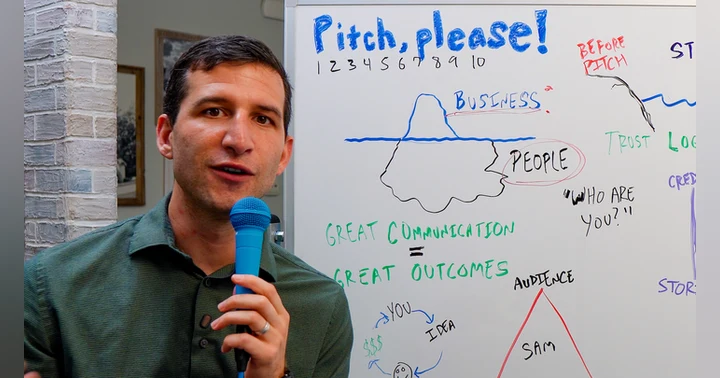
So this is pitch please.
It's a 10 step process to sell to anyone and today we are going to go through step one.
If you'd like, I'm going to put the other 9 videos on this channel and it's going to be super nerdy.
0:16
This is for the business people who have a business, they want to grow it and they also appreciate communication.
This is all about combining communication with the business because most of business is like this iceberg right here.
So at the top of the iceberg, you have business.
0:33
This is the thing that you do, the service that you provide, the good that you create, whatever that is.
Say you bake cupcakes, this is baking the cupcakes.
Say you provide personal training, this is providing that personal training.
Whenever we look at business, when we look at someone who bakes cupcakes, often time we see, OK, they bake cupcakes, but the majority of where the outcome, where the positivity, where the results are going to come from is going to be the people stuff.
1:02
And that's what I'm focused on.
I'm a communication coach, so I help business leaders turn their communication into opportunity, into more revenue.
And there's a lot of different ways to do that.
But we're going to look at today mastering sales and sales is a really big cycle.
1:21
There's four steps to the cycle.
I'll show you what that looks like, but my big thing, and it's something that I want you to leave with, is this right here.
Great communication creates great outcomes.
If you can learn how to become a better communicator, you will generate better outcomes for you and your business.
1:39
Working hard isn't the answer, it's part of the answer.
You need to work hard.
Being good to people definitely part of the answer, but if you can't articulate your value or why what you're selling is important to the people that it's important to, then you're going to have a hard time.
You're not going to make as much as you could make.
1:56
You're not going to have as much of A enjoying, not not as enjoyable of a life and business.
So you're going to burn out faster.
You're going to have a difficult time building a team.
A lot goes to communication.
So great communication creates great outcomes.
I'll show you this a little closer.
2:13
Whenever we think about communication, what you'll see here is that this is what communication looks like.
So there you are, and you're going to have an idea, and your goal is to get that idea to a certain person.
2:34
And ideally they buy into that idea and they give you some money and then it goes back to you.
You figure out what you're going to do with that money, but ultimately the cycle begins again.
Potentially you have a different idea or you have that money and you're just going to retire your business and sell your business.
2:53
More than likely you're not.
So the cycle will continue and continue.
So the better you are at mastering the cycle, then it's going to help you not just for the big pitch you have coming up, which is probably why you're listening to this, but also for every pitch you have in the future.
3:12
OK, now every single moment where you are selling to somebody has what's called a rhetorical situation.
This is really just a fancy way of saying there's communication taking place.
And in a rhetorical situation, there's three different components.
3:31
There's the speaker, there's the audience and the mission or message.
I call this Sam, speaker, audience, mission, Sam, Sam, Sam.
So that's how I remember it is you need to get to know Sam in this video.
I'm only going to talk about speaker because I think this is step one out of 10 and you need to know thyself.
3:52
It's really important about sales is knowing thyself, knowing what makes you different, because people are going to be asking this question right here, which is who are you?
And ultimately, whenever you build a case, case is going to be how we know thyself.
It's going to be your credibility, your alignment, your stories, and your edge.
4:13
What sets you apart?
Then you're not only going to be able to answer this question of who are you, you're also going to be able to answer this question of why you and why not somebody else?
4:30
Those are three different questions.
Who are you?
Why you?
Why not somebody else?
Why not somebody else is the problem and solution aware person's question, who are you is people trying to figure out where there are in this whole thing.
4:48
But why you is much more purchase behavior right?
In order to get them there.
I'm going to show you something and this is how I want you to think about the importance of knowing thyself.
It's because every pitch anytime you're going to sell something to somebody is like this right here.
5:06
You have a before pitch and after pitch, and what you need is you need a bridge.
So you're going to build a bridge from before to after.
So building a giving someone a pitch, selling to someone is essentially you are giving them a story as to why it would be better for them to take part in whatever it is.
5:28
And the way you do that is by building trust, logic and connection.
This is going to be section 4-5 and six.
I've pitch please this process here, but you need to build trust, logic and connection.
5:44
Also very similar to ethos.
Well, yeah, Ethos, Logos Pathos, which is the Aristotelian triangle has been around longer, has been around a lot longer than me, 2400 years.
6:01
Aristotle was talking about the Aristotelian triangle.
There's a reason it's been around so far.
It's Evergreen.
It definitely works.
Also real quick, I'm going to take a quick break from the whiteboard to tell you.
You can get the whole entire guide for this ten step process of becoming an expert at sales by clicking the link in the description below.
6:20
I've made it free for you so that you can read it.
You will also be subscribing to my emails where I send you every new video as soon as it comes out for the Pitch Please series to become an expert at sales.
That link is in the description below.
6:35
Or you can scan the QR code on the screen because I've learned that 60% of people who watch YouTube videos are watching it on TV.
OK, back to the process.
So what does that mean for us?
That means in order for us to build trust, we need to know who we are in order for us to make sense to our audience.
6:56
We have to know who we are in order for us to connect to our audience, we have to know who we are.
So how do we know who we are?
How do we know what makes us unique?
How can we convince the person that we're selling to why they should go with us?
And the answer here is to create your case.
So case is how we think about what sets us apart.
7:16
Cases, our credibility, our alignment, which essentially is our values.
If it aligns with who we're speaking to, the stories that we tell and our edge, what sets us apart?
So there are different questions that we can answer to build the case.
The first one is credibility.
7:33
And the big thought here is if you had to tell somebody one thing that made you credible in this space, what would that one thing be?
What would the one thing be that people talked about in the headlines?
For me, there's different parts of credibility.
7:51
I have 3 pillars of credibility, but if I had to pick one thing, that one thing would be that I've worked with over 120 different business owners.
I have a lot of experience working with business owners.
I've had to pick credibility.
One thing, That'd be it.
But for me, I have 3 pillars of credibility.
8:08
I've worked with over 120 business owners, but I've also created communication content that's been seen by over 150,000 people.
And then I've also run a business of my own.
So I've been in the small business trenches.
8:25
I've closed big contracts, I've been able to build clientele, I've been able to provide a service and then sell the service myself.
So I've been there, I've advised people, but I've also create content so people can understand and be better educated.
So I have three different pillars of credibility there.
8:42
You're going to have different sources of credibility and you need to know what they are.
Let me make sure I have the proper questions whenever I'm asking you this because I wrote them down over here on my laptop.
So a good question would be what's 1 accomplishment you'd mention if you had only one sentence to prove you're the right person for this?
9:04
So what's 1 accomplishment you'd mention if you had only one sentence to prove you're the right person for this?
Another thing is what have you done that most people in the room haven't?
This is great because this is exclusivity.
It sets you apart.
This is also kind of dealing with edge.
9:21
So that's going to be our C for case is we're thinking to ourselves, what is that one thing?
What's that one thing that sets up our credibility?
9:38
It's important to be credible, right?
Some people forget about credibility and they just hop into exactly what's going on.
Credibility is very, very important.
Second, is alignment.
Alignment.
A good way to think about alignment is essentially our values.
9:54
What are your values?
So two key questions here.
If your closest friend or mentor described what you stand for in one line, what would they say?
What does Chris stand for?
For me, no doubt they'd be saying communication.
10:17
I'm like the communication guy for a lot of people online.
I'm like communication in person.
I talk about communication wherever you find me.
Communication, communication, communication.
So they would say he believes in good communication, that people should articulate what they believe in, that people should talk to people.
10:35
I run a whole podcast that has been featured on the Apple podcast homepage called the Talk to People Podcast, right?
It's really in me now.
For you, that's going to be something different.
I really believe in curiosity, connection, and that creates opportunity.
So my values are pro social, collaboration, creativity, getting out there and being yourself.
10:57
Doctor Seuss says there's no one you are than you, and that's truer than true.
That's core to me and that's core to what I do.
But what is that for you?
Another way to think about this is what's a decision you've already made that cost you something but stayed true to what you're building?
11:14
For me, a really important decision that I made was to create a podcast and create free episodes every single week.
As I get busier and as I commit to more things as my family grows, that costs me increasingly more.
11:33
But it's important for me to be creative and do things that I enjoy doing.
I do not have a client who's paying me to put all the stuff on a whiteboard in my kitchen during my hour where my wife is watching our son so that I can do this real quickly, right?
11:51
It's a high cost for me, but I really believe in one, being creative and also equipping people to become better communicators so that they can live fuller lives.
That's something very unique to me.
Not many other people are doing this, so it's important for you to know, and it's important for you to know what that is about you.
12:12
What's that value that's so important you're still committed to it even though it's costing you something.
That's alignment.
For alignment, essentially, you can think about values.
I would call it values, but I like the CASE acronym.
12:30
Then we need to think about stories.
Stories.
If I were working with somebody on step one of the sales process, and whenever I say the sales process, that doesn't mean whenever you meet someone, you have to take them through 10 different steps.
This is the process to become an expert at sales.
12:47
So step one of that process is knowing your stories.
Stories are magic.
I think what makes humans special is that we're storytelling creatures.
We have the ability to articulate our words into a sequence that creates an impact and that brings emotion, and then emotion then results in action, and action is what puts everything together.
13:10
So our stories are binding their social glue, but they're also activators.
They get people to do things because they feel certain ways.
You have unique stories available to just you.
There are some people who get really good at telling other people's stories.
13:29
They get really good at being able to talk about inspirational things that have happened to Howard Schultz or to Jeff Bezos or to Michael Jordan or LeBron James.
These people that are outliers.
That's one skill.
13:44
But here I'm talking about what are the stories unique to you?
For me, I grew up the baby of four.
I grew up in a house that did not have access to a lot of resources.
I was able to witness hard work, and I also learned that working hard does not mean you're automatically going to be successful.
14:06
Because I still saw people struggle.
I witnessed addiction.
I witnessed consequences and cause and effect.
I moved across the state for college and I learned what it was like to show up and not know a single person other than your roommate.
14:23
And then I moved across the country and I learned what it was like to not know a single person at all and then rebuild again.
There are different stories that I talk about on this podcast, but those stories helped me on LinkedIn, on Instagram, you'll see me talk about different stories because stories are connectors.
14:42
They're kind of hacks because we can use stories to connect with people.
Pain and stories, pain and stories.
Everybody's going to experience pain and they're all going to experience stories.
So questions here.
What's the time this problem, whatever problem you address, what's the time the problem personally cost you something or personally cost someone that you know?
15:06
And then what's a moment you knew that this was worth pursuing?
Not just a good idea on paper.
Big stories.
These are what we would call turning point stories, and they give you permission to let someone in the active moment action.
15:23
This is like the Jason Statham movies where he's beating everybody up and flying out of a plane.
There's a lot going on.
Turning points.
We can all identify with turning points.
Transition brings energy.
So stories is that connection piece.
15:41
We're inspired by it.
We feel sad by it.
I'm not even getting into how you properly deliver a story, but that's a science in itself too.
We could get into that later.
And then Edge, what would someone who watched all of all of these businesses pitch to them?
16:00
What would they remember about you specifically a week later?
And what do you believe about this problem that most people in your space get wrong?
Edge is answering the question, why should I pick you and not somebody else?
I understand who you are, but I also understand there's a lot of competition and I have options.
16:21
Why should I forgo my options to pick you and you alone?
This is there's a reason why it's at the very end because it's difficult.
Many people struggle with this.
I remember someone asked me in an interview why should I pick you and not the other applicants.
16:38
And my first thought was, I don't know the other applicants.
I can't answer that question, which is partially true.
But now I realize once you get to understand why you're credible, what your values are, and the stories you get to tell, you'll realize that you are incredibly unique and there's something that sets you apart.
16:59
So answering those questions, what's something that people would remember specific to you?
And then what do you believe about this problem most people in your space get wrong?
As a communication coach, I believe that what many people get wrong is they focus so much on delivery.
17:15
Notice, I haven't talked to you at all about your tone or how fast you should talk, or whether you should open up with a question or whether you should open up with a statement.
I haven't talked to you about your nonverbals, about your gestures.
I haven't told you whether or not you should use a joke or how many jokes you should use.
17:34
That's delivery.
Many people think that's the focus.
That's not the focus.
If you focus on just that you are performing.
People can put on good performances, sure, but if you want consistently good outcomes, then you need to get into the manner of engineering.
17:49
Not performing.
This is engineering.
This is the nerdy stuff.
But nerds rule the world, right?
They know what they're about.
Now, when you combine this with performance, you're on to something.
But when you just focus on performance, you're missing the majority of the reward.
18:10
This is consistent, rather like rather than lucky.
That's something that sets me apart.
That's part of my edge.
Most pitches, most time people are selling, it's not because of the idea, it's not because of the offer.
18:27
Rather, it's because of what sets them apart as someone who's selling, what sets their company apart.
And ultimately, it's going to be this right here, this bridge that they're building from not going with you and your company to it being an absolute no brainer to go with you and your company.
18:45
The more you work on this, the more we walk through this ten step process of how to become an expert at sales, the more you will be able to connect faster, create opportunity and get people feeling genuinely excited.
19:05
You're not tricking them, you are not manipulating them.
You are just able to actually showcase the value of what they can partake in by going with you and saying yes.
This is something that's actually from my process called the rhetorical stack.
It's a 10 step process.
19:21
This is step one.
And be sure to subscribe to the channel so that you don't miss the next 9.


 Spotify
 Apple Podcasts
 Amazon Music
 Pandora
 YouTube